
I just finished reading Walter Isaacson’s Steve Jobs, and one thing struck me more than anything else: Jobs didn’t just build computers. He built objects—objects that were meant to be touched, held, admired, lived with. Objects that communicated something through their very presence.
He hated junk. He hated laziness. He hated “good enough.”
He believed that design was not decoration—it was integral.
And when he stood on the International Design Conference stage in 1983 and said America had forgotten how to design beautiful things, he wasn’t being dramatic. He was telling the truth. He was pointing to a cultural amnesia—a forgetting of craft, of lineage, of pride in making something well.
Jobs wasn’t fast. He was exacting.
He prototyped endlessly. He iterated obsessively. He refused to unveil anything until it was right.
Long before Jobs, long before personal computing, there was another industry that understood the sacredness of design: Haute Couture.
Most people think Haute Couture is just “expensive fashion.” It isn’t.
It is product design at the highest possible level.
It is the art of creating an object—a garment—that is engineered, sculpted, refined, and perfected through a process so meticulous that only a few people are allowed to use the term Haute Couture on their designs.
And its roots go deep.
The seeds of Haute Couture were planted in the late seventeenth century, when Jean‑Baptiste Colbert (financed by the French Government) restructured the French silk industry, positioning France as the global leader in textile design. The voluminous skirts of the era weren’t just fashion—they were an economic strategy. The bigger the skirt, the more French silk the world had to buy.
Centuries later, Christian Dior—backed by Abraham Silks—did the same thing.
After the rationed silhouettes of World War II, he unveiled the New Look: a silhouette so radical, so voluminous, so luxurious, that it not only reasserted France’s dominance in garment design but also single-handedly revived France’s devastated economy by creating a global demand for thousands of unemployed French craftsmen. People who made not just the garments themselves, but the buttons, beads, threads, and everything else that was needed to create them.
Interesting fact: When Christian Dior died unexpectedly in 1957, he was responsible for 60% of all French fashion exports (to be used, primarily, as patterns for the American ready-to-wear industry) and contributed to 4% of the economy; his death created the realistic possibility of a country-wide recession— that's how important Christian Dior was.
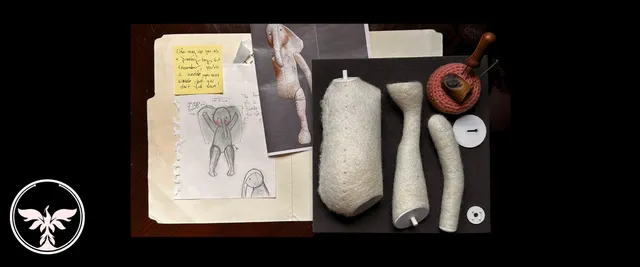
In Haute Couture, everything begins with the toile—the prototype; the first incarnation of the idea—where the designer tests proportion, balance, silhouette, structure.
The toile is corrected.
And corrected again.
And corrected again, until it is right.
Only then does the house move into production.
Ruth Handler spent three years bringing Barbie to market. Three years.
Not because she was indecisive, but because she was building something that had never been attempted before at Mattel . . . creating a doll (before Barbie, Mattel only produced boy or gender-neutral toys).
Mattel had to create the infrastructure from scratch. They had to invent processes. They had to solve problems no one had solved before.
Real product design takes time. Real product design demands patience. Real product design requires the maker to honor the prototype.
Dumbo is no different.
But the deeper truth is this: I am following in the footsteps of makers who understood that excellence is not an act—it is a philosophy. And philosophies cannot be rushed.
So here is the invitation…
Look at your own life and ask yourself where you’ve been rushing and what deserves to be refined, where you’ve been pushing for speed instead of clarity, where you’ve been trying to “ship” something that isn’t ready—not because you lack discipline, but because the world has taught you to value immediacy over intention.
Let yourself slow down.
Let yourself return to the prototype stage—where ideas can be corrected, reconsidered, reshaped, and made true. There is no shame in revision. There is no failure in patience. There is only the quiet integrity of making something worth making.
Whether you’re building a career, a relationship, a dream, or a version of yourself, honor the parts that need time. Honor the parts that need craftsmanship. Honor the parts that need you to think, refine, and begin again.
Because the things that matter—the things that last—are never the ones made quickly; they are the ones made well.
Until next time, be well and peaceful,
The Billy J
Your Perpetually Friendly, Neighborhood, Cosmic, Jedi-Surfer